
Reset, Recover, & Rebound: When Your Training and Race Goals Derail
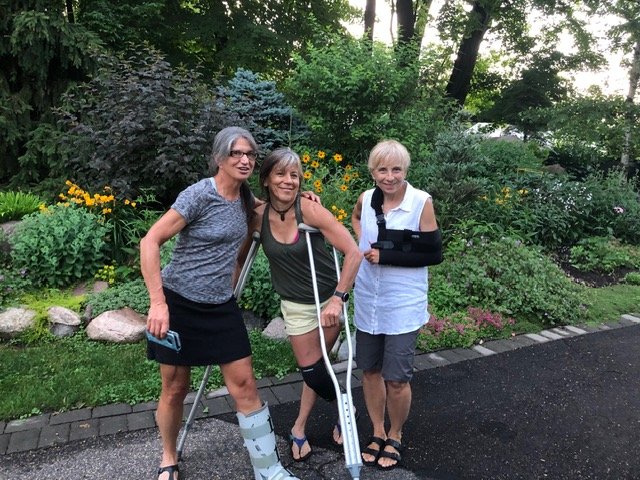
I broke my tibia, fibula, and five ribs in May 2019, on the eve of my 60th birthday, all from a stupid bike crash. Lack of attention had me hit a pothole at flying speeds while tucked in my aerobars. Yet luck surrounded me: my head and spine were intact. So, my first lesson: embrace gratitude. Over that summer, with as much cheer as I could muster, I reset my mental goals. With my doctor’s orders of no weight bearing for three months, a long comeback ensued, from use of a walker and then crutches. My first movement using two feet with a cane didn’t come until September 1st.
My new goal? To accomplish my yearly goal, which was to skate the 50K Birkie as fast as my body would allow. Yet my normal training schedule was totally messed up. Minuscule glute rehab movements did not prepare my legs for my first ski on manmade snow in mid-December. Even after 6½ months post-accident, my legs would not complete even the very basic skate technique.
Super discouraged, I could not stay with the other skiers. Mechanically, my leg would not cooperate. As I later learned, my glute and abductor had not yet developed the strength needed to pull in my leg after the skate push off.
Making the Needed Adjustments
What follows is my recovery timeline summary, from my accident in May until my first December ski:
June through August: I allowed my body to heal. My body felt surprisingly stressed and even a short workday at Gear West left me asleep on the couch by early evening. My short-term goal? To cope with the loss of exercise.
From starting Ironman Madison training in March, to then realizing my entire summer would see zero aerobic workouts, I knew weight gain would exacerbate my disappointment. I eliminated carbs from my diet for a solid three months. This discipline was a serious accomplishment. (Never to be done since!) I love eating chocolate and bread. All I could do was heal up and find other new activities to try; for me, that included drawing classes, something I never have had time to do.
I kept my mind focused not on what I lost but what I could gain.
September: At last! The doctor cleared me to bear weight. The moment I discarded my crutches and shuffled across my store’s floor is etched in my memory. My leg was shrunken, my ankle lost range of motion, and I needed a cane. Return to motion began at a snail’s pace.
But I was ecstatic just to be able to carry a cup of coffee from the kitchen to my desk! Small accomplishments are huge wins.
October. I hobbled through our Gear Western 5K run. Not fun: my right leg dragged with every stride. Glute bridges, lots of them, were the only strengthening tricks I liked to do. I made no time for other physical therapy.
During this time, my husband was recovering from neurosurgery and I watched him fight the loss of his pituitary and much of his eyesight; I could not complain about my issues.
There is always someone worse off than you.
November: Gear West’s ski season started and life was a blur with work. I fell into my old routines, trying to run and rollerski, hoping I was healed. Yet I tripped a lot doing the simplest things. My feet did not obey my head when climbing stairs to my office.
A physical therapist customer noticed how I continued to walk with a limp, and introduced me to the value of expanding treatment. I gave her a pair of excellent carbon ski poles in exchange for treatment, and we have since become good friends.
Regaining functional strength from an injury will require targeted physical therapy exercises. Bypassing PT will delay recovery. Become buddies with a PT person!
December: For two weeks, I diligently worked at glute exercises. I had fun learning the many creative ways to strengthen tiny but important muscles. I looked forward to cross-country skiing since the movement was much kinder on my knee than running. But my first experience on man-made snow was a rude awakening.
I knew rebuilding my fitness would be a tough go, but the degree of floppiness surrounding my damaged leg destroyed my fragile confidence. While my skiing friends were lazily gliding over the hills on their skate skis, chatting away, I couldn’t catch my breath. I was so out of shape from a summer of humping around on crutches and I had to manually manipulate a lazy leg. I was startled to realize just how far behind I was.
Understand that the road to recovery will offer up more potholes. PATIENCE, yes, all caps(!), is key. Patience and not giving in.
The Value of New Goals
What to do when your original silent sports hopes and dreams become derailed by an accident, illness, or sudden life change? What to do when your plans to ski the next Birkie crumble? And if your carefully constructed training schedule to reach that faster wave or age group podium, or to complete the course with joy, suddenly collapses?
All I can offer up is the mental reorganization that my competitive, complicated mind had to embrace if I was going to achieve any sort of success. The focus I chose and the help I received worked … eventually.
My Steps to Recovery
1) Take stock of all the good things you have: As in any recovery plan, give the “poor me” attitude only a minute or two of life, then bury it. When fitness plans disintegrate due to health or work issues, there is no magic bullet, no quick fix, that will direct you back to full health and recovery overnight. To do the work and to redesign a new, albeit modified, training plan, you must see life as a glass full.
2) Build a gratitude list: This phrase is used often in times of trouble, but strength springs from acknowledging the truth. If we can consider “skiing the Birkie” at any speed, as our goal, we have much to be grateful. Find your personal reasons to be thankful. Write them down and look at them if not daily, then weekly.
3) Determine and embrace a new, realistic goal: Create by yourself or with a knowledgeable friend, a fresh, longer-term, slower-moving training regimen to rebuild your body safely, and to minimize new injuries. Do so within your own doctor’s and PT’s set limits.
4) Follow the three C’s of physical recovery. I read an article in the Experience Life magazine which highlighted the “3 C’s of lifelong fitness.” In the context of this article, I amended the title and applied the following lessons:
Consistency: Stick with your goal. Be wise and choose a goal which you can achieve through focus and discipline. Sporadic workouts will not create success. Mentally, you must focus on the feeling of achievement and identify the sacrifices needed to be made. Decide if it is doable and then commit.
Curiosity: Minimize your regret of losing your pre-incident abilities. Be forward thinking and curious. Research the best training to address your unique challenges. There is a smorgasbord of information out there on training and overcoming injuries. Combine your studies with professionals in the health and athletic fields to develop exciting, fresh ways to rebuild your fitness. Improve nutrition, introduce yoga, learn mobility movements, work on balance.
Compassion: Absolutely introduce compassion into your plan. Be kind to yourself and delight in what you can do.
You Are Still Goal-Achieving!
Of course, your goal will be modified by whatever redefined your life, short or long-term. Yes, your finish time will not be as you had hoped, or may not surpass your friends’ achievements. Therefore, return to what is important: Personal satisfaction.
Nobody pays as much attention to, or cares as much about your race times, as you do. If that’s not the case, you may need to consider getting new friends. It’s always easy to smile at your results when everything goes right. The real accomplishment happens when you surmount, with grace and humor, all that goes wrong.
Even without the lingering effects of my injury, at 63, I understand and accept that my body does not ski the speeds or handle the training loads I once did years earlier. Expectations must be reset and realistic achievements celebrated, otherwise you will set yourself up for continual disappointment. If you miss another day of training, forgive yourself and move forward. Understand the value of rest and don’t agonize about taking another easy day if recovering from illness or injury. Figure out a good, better, and best day, and then reward yourself when sticking to one of those options.
My 2020 Birke Result?
A respectable finish, at least up to the International Bridge on Main Street, a hundred yards from the end. At the base of this climb, which can barely be defined as a hill, I almost slid backwards. My entire body was so exhausted I literally stumbled on my skis the rest of the way into Hayward.
The Birke took all that I had, yet I learned so much during the journey. I lost a summer of fun but gained enough resiliency and empathy for other injured souls, to last me a lifetime.